
Domain 1
Site, Soil & Subgrade
Grade, soil, soil gas, and orientation — decided before the slab and unrecoverable after it.
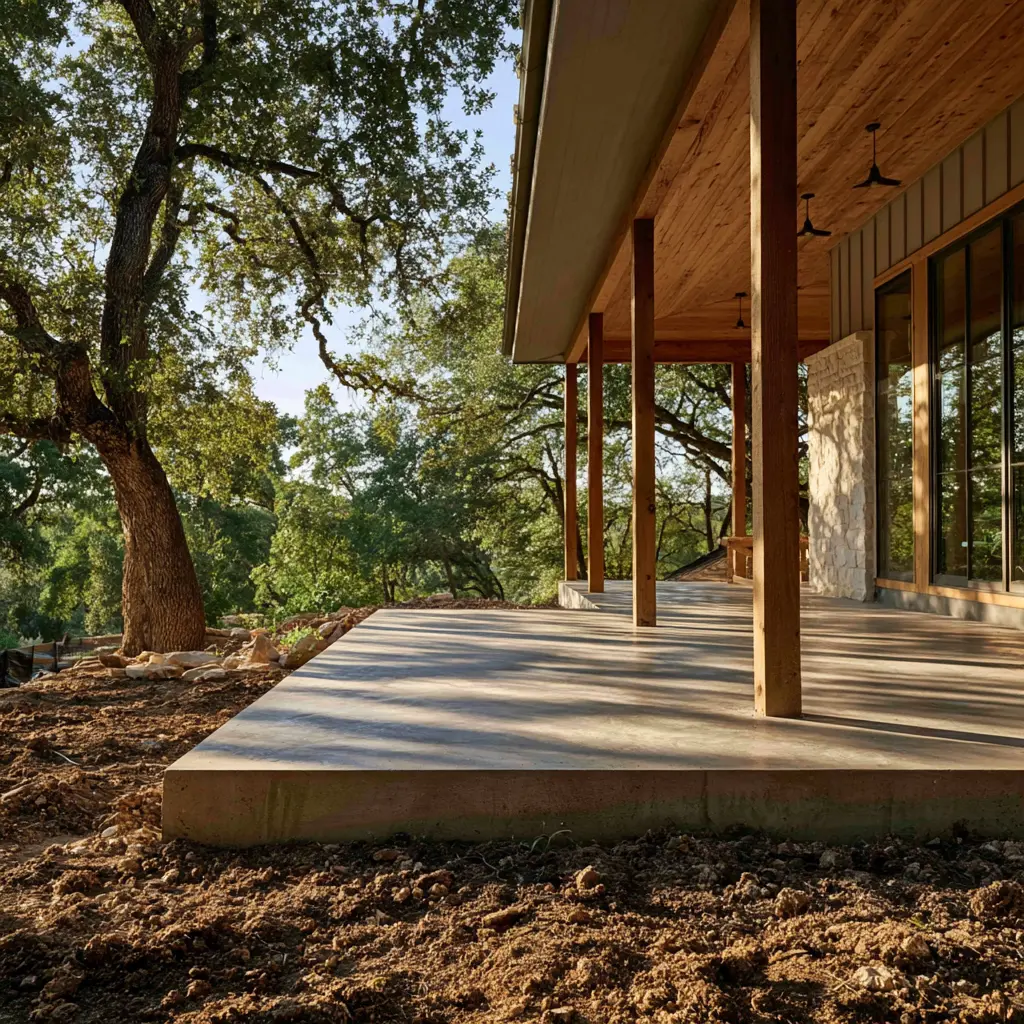
What this domain covers
This domain is about the ground the house sits on and everything around it that the house cannot later change. It covers finished grade and how the site sheds water; the soil classification and how the soil behaves under a foundation; the gas that moves through the ground beneath the slab, including radon; the vapor barrier below the slab; flood elevation; and a survey of what sits upwind, uphill and next door — roadways, rail, agriculture, industry, neighbouring septic, floodplain position, transmission lines and exterior noise.
It also records the parcel's regulatory position and its solar and wind orientation, and hands those on as fixed inputs to the domains that depend on them.
Why it matters in Central Texas
The corridor sits in climate zone 2A — hot and humid. East of the Balcones Escarpment the soils are expansive clay that swells and shrinks as its moisture content changes, and moves foundations as it does. West of it, shallow soil lies over fractured rock.
Rain here arrives in short, violent events rather than steadily, so how a site carries water away from the structure matters more than what falls in a year. And the published ground-gas designations for these counties rest on thin county-level data that does not describe an individual lot, so Sage Co. assesses the site rather than assuming it.
How depth is chosen
A client elects Essential, Enhanced or Comprehensive for each domain separately, and a domain offers only as many rungs as it honestly has.
This domain has no ladder. Every requirement in it closes before the foundation is in the ground and cannot be added afterwards, so it sits on the floor and is the same on every project, whatever depth is chosen elsewhere. A client may still decline something here; that decision is written down as a named exception and listed wherever the house is described.
What we document
Findings are entered in the Sage Co. Record: the engineering basis for the foundation, the ground-gas results with the instrument and dates, dated photographs taken before anything is covered, grade and drainage measurements, the survey of adjacent conditions with its signed disclosure, and the orientation and regulatory findings handed forward.
Verification here is by an independent third party, by instrument and by review of the file. Sage Co. may record that something is specified and installed; only that third party records it verified.
Findings in this domain are recorded in the Sage Co. Record. Sage Co. may mark a requirement specified and installed. Only an independent third party can mark it verified, and verification is elected domain by domain — how verification works.
Reviewed by Jake Rangel, September 19, 2026
Related reading
- Residential radon concentration measured against lung cancer risk in 13 European case-control studies
- Residential radon concentration measured against lung cancer risk in seven North American case-control studies
- Prenatal residential proximity to agricultural pesticide applications measured against autism spectrum disorder and developmental delay in a California case-control study
- Residential proximity to major roads measured against incident dementia, Parkinson's disease, and multiple sclerosis in an Ontario population cohort
- Handbook published on indoor radon from a public health perspective
- Review of traffic-related air pollution emissions, exposure, and health effects reported in HEI Special Report 17
Build this into your house
Sage Co. builds and consults across Austin, San Antonio and the Hill Country. Start with a call and we will walk this domain — and the other ten — against your project.